|
Train to Sapa |

|
|
|
|

|
Quick Search |

|
|
|
|

|
Vietnam Weather |

|
|
|
|

|
Exchange Rate |

|
|
|
|

|
Site Statics |

|
|
|
|

|
Sapa Photos |

|
|
|
|
|
 |
|

|
Train to Sapa - Sapa Train Tickets, Information and Reservation |

|
|
|
Getting there Two main roads wend their way into the north western mountain area: the latter part of the trip offers good views, but the roads are poor and the twelve-hour journey is tiring. For most visitors, overnight train travel from Hanoi to Lao Cai and by road to Sapa is the best option.
Sapa’s history Sapa came into existence as a hill station during the French occupation. Previously a Black H’mong village, it was ‘discovered’ early in the twentieth century and developed as a resort for French military officers, civil servants and business people. Its marked similarity to alpine areas in France and its temperate climate made it a haven from Hanoi's clammy winter dampness and sultry humid summer. By 1940, it was a sizeable town populated almost entirely by French citizens.
Sa Pa today Today, a few buildings have been restored, notably the church, shelled by the French as the Viet Minh began to advance through the northern mountains. Several of the new buildings are vaguely based on the long gone French villas – the Auberge Hotel is a good example. Apart from that, the only enduring memento of the French presence is the inclusion of open fires and chimneys in many buildings – a welcome addition as the temperature often slips below zero in winter.
The ethnic minority groups The main attraction of this area, apart from its superlative natural beauty, is Vietnam’s largest concentration of ethnic groups. Many distinct groups live in this area and, apart from those living around the tourist centre of Sapa, their dress, buildings, traditions and lifestyles have changed little over the last hundred years. |
|
|

|
Special Offers |

|
|
|
|
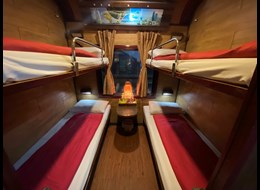
Victoria Express Train recalls a more romantic era. Passing through the exotic landscapes of North Vietnam, between the charming cities of Hanoi and Lao Cai. Each sleeping carriage has 6 superior cabins (4 berths) and 2 deluxe cabins (2 berths)
|
|
|
 |
|
|
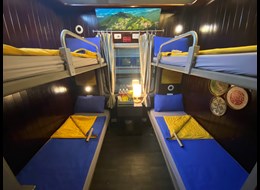
Tulico train offer comfortable, air-conditioned soft sleepers. While this is not a luxurious train, it offers good alternative transportation to Sapa from Hanoi. It has soft sleepers, A/C and clean four-berth cabins.
|
|
|
|
|
|
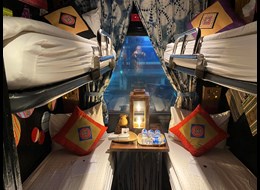
King Express train carriages, en route Hanoi- Laocai reflect the charm of colonial traveling style in northern Vietnam. King Express Train offer an inspirational experience onboard as well the time to enjoy the beauty of evocative destinations.
|
|
|
 |
|
|
Livitrans is a newly built train connecting Hanoi and Sapa. It is considered one of the most luxurious trains in Vietnam with its equipment equivalent to a high-class hotel. Livitrans feature sleeping carriage with 2 berths, 4 berths and 6 berths, a bar, toilets, LCD
|
|
|
|
|
|
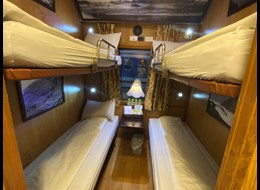
Fansipan Express Train with airconditioning wooden 2 berths and 4 berths cabins. Each berth is equipped with reading lights, baggage storage, flower, mineral water and napkin.Fanxipan Express has a tool providing cold and hot water.
|
|
|
 |
|
|
Like the other Sapa tourist train, Pumpkin Express Train is not a separate train, it offers soft sleepers, A/C and clean four-berth cabins. Bread & small bottle of water are supplied in every one for free
|
|
|
|
|
|
The TSC Express Train is wooden carriage, soft sleeper AC cabin with soft 4 berths and two toilet at either ends. Each berth is equipped with individual reading lights, baggage storage and spacious trunk for suite case and hand luggage.
|
|
|
 |
|
|
The brand new Hara Express Train has just been introduced to operate routing Hanoi - Lao Cai - Hanoi with 4 fully decorated carriages with high standard soft sleepers with airconditioning wooden cabins with soft 2 berths cabin
|
|
|
|
|
|
|
|